How to Budget with Variable Income: A Month-to-Month Method
A variable paycheck is not the same thing as an unpredictable life. The useful distinction is between money that has actually arrived, money that is already assigned, and money that is still only expected. This guide turns that distinction into a month-to-month method with a short weekly cash check.
- Plan the floor first. Use essential monthly costs and a conservative view of income before you decide what flexible spending can fit.
- Count cleared money, not promises. An invoice can be recorded and still remain unavailable until the payment arrives.
- Keep one unallocated cash pool. Existing tax reserves, known-bill funds, and emergency savings stay outside it. Actual expenses paid from the pool reduce it, a new assignment reduces it once, and a later payment from that assigned reserve reduces the reserve ledger, not the pool again.
- Check cash weekly. Enter $0 when no income arrived. A shortfall is information that calls for a real adjustment, not a made-up number.
In this guide
The core idea: budget cash you can use
When you are paid by project, shift, commission, contract, or season, a monthly budget needs two views. The first is a planning view that looks at your history and recurring commitments. The second is a cash-flow view that asks what has cleared and what must be paid before the next payment is likely to arrive.
The Consumer Financial Protection Bureau cash-flow budget tool uses this second view. It starts with a beginning balance, adds income and resources received during the week, subtracts expenses, and carries the ending balance into the next week. If the result is negative, the week is short. That is a useful signal even when the monthly total looks comfortable.
For a planning baseline, look at a longer history if you have one. For example, if the last 12 months contain $48,000 of income actually received, the historical average is $48,000 / 12 = $4,000 per month. That average can help you compare a weak month with a strong month. It does not turn next month's expected invoice into cash, and it does not prove that $4,000 will arrive every month.
Use history to plan, then use cleared cash to decide
A historical average gives context. A cash check protects the next payment window. Keep both numbers visible instead of asking one number to do two different jobs.
Planning view
Review received income over several months and identify the lowest reasonable baseline for essential costs.
Cash view
For a completed interval, start with unallocated cash at the beginning of that interval, before its receipts and payments. For a forward check, start with reconciled current unallocated cash and add no receipts already included in it.
Decision view
Send stronger-month surplus toward known commitments, reserves, or flexible spending only after the floor is covered.
Build a cash map before setting limits
Before choosing a category limit, label each amount by what it means. This prevents a common variable-income mistake: adding an invoice, an account balance, and a transfer as if they were three separate sources of money.
| Label | What it means | How to treat it |
|---|---|---|
| Income received | Money that cleared into an account or was actually received as cash. | It can enter the cash-flow calculation. |
| Unpaid invoices | Work billed or promised, but not paid yet. | Track it for follow-up, but keep it out of available cash. |
| Existing allocated money | Money already assigned to taxes, a known bill, a goal, or an emergency reserve, outside the unallocated cash pool. | Keep its assignment visible. Do not add it as new income. If it pays an expense, reduce this separate reserve ledger, not unallocated cash. |
| Essential monthly expenses | Costs needed to keep housing, utilities, food, transport, insurance, and minimum obligations current, whether funded from unallocated cash or an assigned reserve. | Subtract only the share funded from unallocated cash. A payment from an assigned reserve reduces that reserve ledger only. |
| Tax reserve | An amount newly assigned from unallocated cash for your own tax situation after income is received. | Subtract a new assignment once. A later payment from that reserve is not a second subtraction from unallocated cash. |
| Money available | Unallocated money after starting unallocated cash, cleared income, explicit reserve releases, actual expenses paid from unallocated cash, and new assignments are reconciled. | Use this number for decisions. Separately assigned reserve balances stay outside it, and transfers between your own accounts are not income. |
A verified three-month example
Imagine Sam, a freelance designer in the United States. The following numbers are fictional and exist only to show the method. At the start of January, Sam already has $1,200 assigned to a tax reserve and $900 assigned to annual bills. That is $2,100 of existing allocated money outside the unallocated cash pool. It remains assigned, is not added to the month's income, and is not spent in this fictional three-month example.
Sam also starts January with $0 of unallocated carry-forward. Each completed month below records money received and expenses paid from unallocated cash during that period, not the value of work that has been invoiced. This fictional example has $0 of other actual spending paid from unallocated cash in each month, so the ending amounts stay the same after that category is included. Every essential expense shown is also paid from unallocated cash. Each ending amount is a reconciled actual balance, not a budgeted or projected remainder.
Received money and unpaid invoices are different numbers
The orange amount is visible for follow-up, but it is not available for this month's bills until it clears.
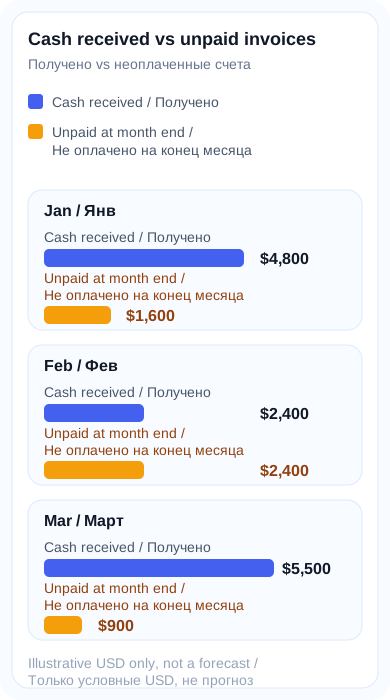
| Month | Starting unallocated cash | Income received | Unpaid at month end | Essential expenses paid from unallocated cash | Other actual spending paid from unallocated cash | New tax assignment from unallocated cash | Reconciled ending unallocated cash |
|---|---|---|---|---|---|---|---|
| January | $0 | $4,800 | $1,600 | $2,900 | $0 | $800 | $1,100 |
| February | $1,100 | $2,400 | $2,400 | $2,900 | $0 | $400 | $200 |
| March | $200 | $5,500 | $900 | $3,100 | $0 | $900 | $1,700 |
January: $0 + $4,800 - $2,900 essential paid from unallocated cash - $0 other actual spending paid from unallocated cash - $800 new tax assignment from unallocated cash = $1,100. February: $1,100 + $2,400 - $2,900 essential paid from unallocated cash - $0 other actual spending paid from unallocated cash - $400 new tax assignment from unallocated cash = $200. March: $200 + $5,500 - $3,100 essential paid from unallocated cash - $0 other actual spending paid from unallocated cash - $900 new tax assignment from unallocated cash = $1,700. Across all three months, $0 + $12,700 received - $8,900 essential expenses paid from unallocated cash - $0 other actual spending paid from unallocated cash - $2,100 new tax assignments from unallocated cash = $1,700 reconciled ending unallocated cash. The existing $2,100 allocation is intentionally outside this pool and is not spent, and transfers between your own accounts do not change the total.
If opening unallocated cash is $100 and a separate $600 reserve is already assigned, paying a $600 bill entirely from that reserve leaves unallocated cash at $100 and reduces the reserve to $0. It is not $100 - $600 = -$500. If $600 is newly assigned from an opening $1,000 unallocated pool and then pays the bill in the same period, the pool ends at $400 and the reserve at $0: subtract the new assignment once, not the later reserve payment again.
Reserve release counterexample. If opening unallocated cash is $100, a separate $600 reserve is assigned, and you deliberately release $200 back to the pool with no income, spending, or new assignment, reconciled unallocated cash is $300 and the reserve is $400. No new money was created. A transfer between your own bank accounts without changing the assignment is not a deliberate reserve release.
What the late payment changes
Sam sent a $1,600 invoice in January. It was still unpaid at the end of January and February, so it appears in the unpaid column and nowhere in available cash. At the end of February, the $2,400 outstanding total consists of that $1,600 invoice and a new $800 invoice. The client paid the original invoice on March 8. It is included in March's $5,500 received amount, and it is not counted again as a separate March income line.
February is the important stress test. Income received is only $2,400, while essential expenses are $2,900. Sam can cover the gap because January left $1,100 unallocated. After the $400 illustrative tax allocation, $200 remains. If that carry-forward had not existed, the table would show a real shortfall instead of silently treating the unpaid $2,400 as spendable.
The tax amounts in this fictional table are planning entries, not a tax calculation or a recommended rate. Tax treatment depends on location, income type, withholding, deductions, business structure, and other facts. Keep a record of what you reserve and verify the obligation with the relevant tax authority or a qualified professional.
The month-to-month method
Use the following sequence at the start of each month. It is deliberately less precise than a promise and more precise than guessing.
Six decisions before flexible spending
Make the order visible. A strong month can then improve the next month without making a weak month impossible.
Choose the floor
List essential monthly costs and compare them with your lower-income months. Do not build the essentials around a payment that is merely expected.
Separate waiting money
Keep unpaid invoices in a separate list. Add them to cash only when the payment has cleared and the amount is recorded once.
Reserve deliberately
After a receipt clears, assign the amount needed for taxes and known obligations from the unallocated pool using your own rules. A new assignment reduces that pool once; a later payment from the assigned reserve reduces the reserve ledger only.
Use the remainder honestly
Only unallocated money left after every essential and other expense paid from the pool, and every new assignment from the pool, can support flexible spending, extra goals, or a buffer.
Reset without punishment
If the month misses the plan, update the next plan with the facts. Do not erase a real shortfall by lowering a number that was already paid.
Carry one reconciled balance forward
Record the reconciled ending unallocated amount once as the next starting amount, and keep assigned-reserve balances in a separate ledger. An explicit reserve release is a reallocation, not income, and a transfer between your own accounts does not create new money.
Use the average of received income over a longer period to understand the range and to test a plan. Use a lower month or a conservative baseline to protect essentials. Never pre-spend the average, an invoice, or a forecast before cash is available.
The weekly actual-cash and affordability check
A monthly budget can hide a timing problem. Rent or insurance may be affordable across the month, but a payment can still fall before the next client deposit. Use two non-overlapping intervals in a five-minute weekly check: first reconcile what happened since the last check, then look ahead to what is due before the next one.
- Close the completed interval. Start with the reconciled unallocated amount at the beginning of that interval, before its receipts and payments, after the prior check has been closed.
- Add actual receipts from that interval. Use cleared deposits and cash received since the last check. Enter $0 when nothing arrived, and do not add an unpaid or future invoice.
- Subtract expenses actually paid from unallocated cash. Record essential and other actual spending paid from the pool in the completed interval once. If an assigned reserve paid an expense, reduce that separate reserve ledger instead of subtracting the payment from unallocated cash. Do not put upcoming bills in this past-period ledger.
- Subtract new assignments made in the completed interval. If you reserve money for taxes or a known bill from unallocated cash, record that allocation once. A later payment from that assigned reserve is not another subtraction from the pool.
- Record a deliberate reserve release. If you deliberately return part of a separately assigned reserve to unallocated cash, add it to the pool and reduce the reserve ledger by the same amount. It is a reallocation, not income. A transfer between your own bank accounts without changing an assignment is not a deliberate reserve release. The result is reconciled current unallocated cash.
- Start the forward check from reconciled current unallocated cash. This is the amount after the completed interval, so do not add receipts already included in it, future income, or unpaid income. Use only additional cash that will actually be available before the due date; in a simple check, $0 means none. If a new receipt clears, reconcile current cash again before rechecking.
- Subtract upcoming obligations once. Subtract only obligations not already covered by separately assigned reserves. A genuinely new assignment reduces unallocated cash once, and its later reserve-funded payment is not subtracted again. A negative result is a projected funding shortfall, not actual negative cash or a month-end carry-forward.
Current cash and upcoming bills answer different questions
This fictional check starts with $450 of reconciled current unallocated cash. All $600 of upcoming essential bills are unfunded by separately assigned reserves, and no additional cash is available before they are due, so the projected funding gap is $150, not negative actual cash.
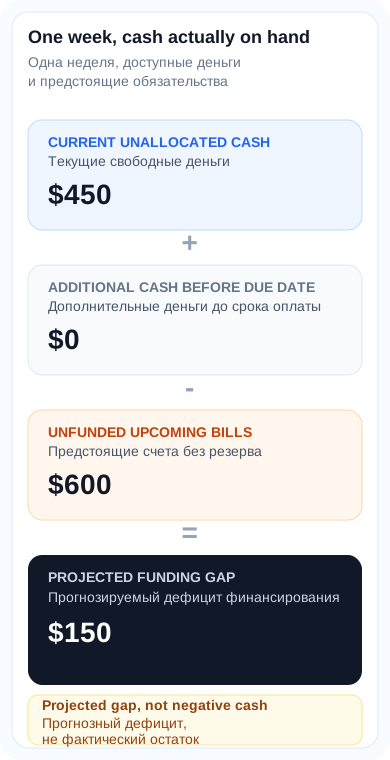
In this forward-looking example, the honest result is a projected $150 funding shortfall because all $600 of the upcoming bills are unfunded by assigned reserves. The next step is not to enter an unpaid invoice as income or to call current cash negative. Depending on the situation, a person might review flexible spending, contact a bill provider before the due date, use an already designated reserve if it is appropriate, or seek local support for the bill. None of those actions is guaranteed, and debt or tax decisions may require qualified advice.
Receipt-already-included counterexample. If reconciled current unallocated cash is $900 and already includes a $500 receipt, and an upcoming $400 bill is not covered by an assigned reserve, the projected amount is $900 - $400 = $500, not $900 + $500 - $400 = $1,000. Do not add a receipt twice, and do not add expected or unpaid income.
Actual-spending example. If a completed interval starts with $1,000 of unallocated cash, receives $0, includes $600 of essential expenses paid from unallocated cash, $150 of other actual spending paid from unallocated cash, and $0 of new assignments, the reconciled current balance is $1,000 + $0 - $600 - $150 - $0 = $250. If the next interval has another $600 due and it is not covered by an assigned reserve, start its forward-looking check at $250 and do not subtract the already paid $600 again.
Annual expenses are not emergencies
A known expense belongs in a plan. An emergency reserve is for an unplanned financial shock. Mixing the two makes both balances hard to understand.
For example, suppose a $1,200 insurance bill is due in six months and $300 is already allocated to it. The remaining amount is $1,200 - $300 = $900. If the timing and cash flow allow, the simple monthly planning amount is $900 / 6 = $150. That is an illustrative allocation for a known bill, not an app feature and not a complete sinking-fund plan.
The MoneyHelper explanation of sinking funds distinguishes regular saving for a known future cost from an emergency fund for an unexpected cost. The CFPB emergency-fund guide gives examples such as a car repair, medical bill, broken appliance, or loss of income. It also notes that the amount needed depends on a person's situation and that even a small amount can provide some security.
Some MoneyHelper guidance discusses building toward three months of essential outgoings for emergency savings. Treat that as a possible target discussed in UK guidance, not a universal threshold or a promise that one number fits every household. Start with what your current cash flow can sustain, then revisit the target as circumstances change.
This article stops at the distinction. It does not replace a dedicated guide for calculating multiple annual funds or deciding where to hold savings. For the emergency-fund side, see the existing emergency fund tracking guide.
Reader worksheet
Copy this structure into paper or a spreadsheet. Leave expected invoices in their own column, fill the received column only after money clears, and record every expense paid in the completed period. The worksheet is intentionally outside the app so the method remains usable with any account setup.
Monthly formula: starting unallocated cash at the beginning of the interval + income received during the interval + explicit releases from assigned reserves - essential expenses paid from unallocated cash - other actual spending paid from unallocated cash - new assignments from unallocated cash = reconciled ending unallocated cash. Enter each completed-period transaction once. Payments from assigned reserves reduce the separate reserve ledger only, not this pool. Keep unpaid invoices and transfers between your own accounts visible, but do not add them to the formula as new money. A forward check starts now, after reconciliation, and adds no receipts already included in current cash; carry only the reconciled actual ending balance into the next period, not a budgeted or projected remainder.
An optional Money Vault log
If you want a place to record what actually happened, Money Vault is an optional iOS-only log for iPhone with a free path and optional Money Vault Pro subscriptions. For this method, use it as a record of cleared income and expenses, then apply the worksheet and tax decisions yourself.
Keep the cash picture visible
Money Vault is an iOS-only iPhone log with a free path and optional Pro subscriptions. It is a log, not individual tax advice.
Do not assume that a spending log calculates your tax liability, syncs bank accounts automatically, forecasts future income, sends the exact reminders you need, or contains this worksheet inside the app. Those are separate questions to verify before relying on any product. Money Vault does not replace the CFPB tools, local tax guidance, or professional advice.
FAQs
How should I budget if my income changes every month?
Start with essential costs and a conservative baseline from your history, then use a weekly cash check to handle timing. A longer-term average can provide context, but it is not spendable money until received.
Should an unpaid invoice count as income?
Track it as expected or outstanding income, but do not count it as available cash. Add it to the cash-flow calculation only when the payment clears, and record it once.
What percentage of variable income should I reserve for taxes?
There is no universal percentage that is safe for every person. The answer depends on jurisdiction, income type, withholding, deductions, business structure, and other facts. Keep a separate planning line and verify it with the relevant tax authority or a qualified professional.
What if I receive no income this month?
Enter $0 in the received-income field. For a completed period, start with unallocated cash at the beginning of that interval and reconcile expenses actually paid from the pool and new assignments. Payments from assigned reserves reduce their separate ledger only. Record a deliberate reserve release by adding it to unallocated cash and reducing the separate reserve ledger by the same amount; it is a reallocation, not income. A transfer between your own bank accounts without changing an assignment is not a deliberate reserve release. For an upcoming period, start with current reconciled unallocated cash and compare it with costs due that are not already covered by assigned reserves, without adding future or unpaid income. If the projected result is negative, name the funding shortfall and decide what real action is available instead of inventing income.
Are annual bills emergencies?
A bill you know about belongs in planned spending, even if it is paid once a year. An emergency fund is for an unplanned shock such as a repair, medical bill, or loss of income. Keep the two purposes separate.
What happens when a bill is paid from an assigned reserve?
Reduce the separate reserve ledger when the bill is paid, but do not subtract the payment from unallocated cash again. A new assignment reduces unallocated cash once, while an explicit release back to the pool is a reallocation, not income.
Can an app create this budget for me?
An app can help you record transactions and review information, but the method still needs your decisions about what is received, allocated, essential, and expected. Verify current product capabilities instead of assuming that tracking means forecasting, tax calculation, or bank synchronization.
Sources and limitations
Primary sources checked for this guide
These source links support general educational guidance, not individualized financial advice. The CFPB and MoneyHelper pages listed below were checked for this guide on October 2, 2026.
- CFPB, Creating a cash flow budget, for beginning balance, received income, expenses, ending balance, and carrying the balance into the next week.
- CFPB, An essential guide to building an emergency fund, for examples of unplanned expenses, cash-flow timing, and the point that the appropriate amount depends on the person's situation.
- CFPB, Your Money, Your Goals toolkit, for the related income, spending, bill, and cash-flow tools.
- MoneyHelper, How to budget for an irregular income, for the lowest-month baseline, tax planning, and emergency-fund context.
- MoneyHelper, Sinking funds explained, for the distinction between known future costs and unexpected emergencies.
The example is not a salary statistic, customer story, personal test, or savings claim. The numbers are fictional and every displayed total is a worked calculation. Tax, debt, investment, legal, benefit, and emergency decisions can depend on facts outside this guide.