How to Build Sinking Funds for Annual Expenses

Written by the Money Vault editorial team, the developer of Money Vault. This is general educational information, not individual financial, tax, debt, investment, or legal advice.
An annual insurance premium, membership, or school fee can be predictable and still feel large when it arrives at once. A sinking fund is a balance you set aside for one known future cost. To choose a contribution, start with the bill's due date and current estimate, subtract what is already reserved for that bill, then divide the remainder by the number of deposits you can actually make before the payment deadline.
Choose bills with a known date
Start with bills that have a clear due date, such as an annual insurance renewal, membership, license renewal, or camp fee. Use the latest statement or notice for the estimated cost. If the provider changes the price, update the estimate and recalculate.
Write down when the payment must be sent or cleared, not just the month it is due. The CFPB's Bill Calendar Tool suggests listing bills, amounts, payment dates, and dates money arrives. A calendar helps you see the deadline; the fund worksheet below tells you what amount remains for that one bill.
Calculate contributions from real deposit dates
Use these two steps:
remaining = max(0, bill cost - amount already reserved for this bill)
contribution = remaining / N, only when N > 0
N is the number of actual scheduled deposit dates before you need to send or clear the payment. Count the dates on your plan. Do not round the number of calendar months up and call it the number of deposits. The CFPB's Savings Plan Tool uses a goal amount and time window to set a savings target; for a bill that is partly funded, use the remaining amount and the real deposit dates in that window.
Only money you have received and can currently use can become a contribution. A date on the plan is not money in the fund. If a paycheck or other payment has not arrived, do not add it to the balance. When a planned date passes without a contribution, remove that date from N and recalculate with the dates that remain.
Three examples with different deadlines
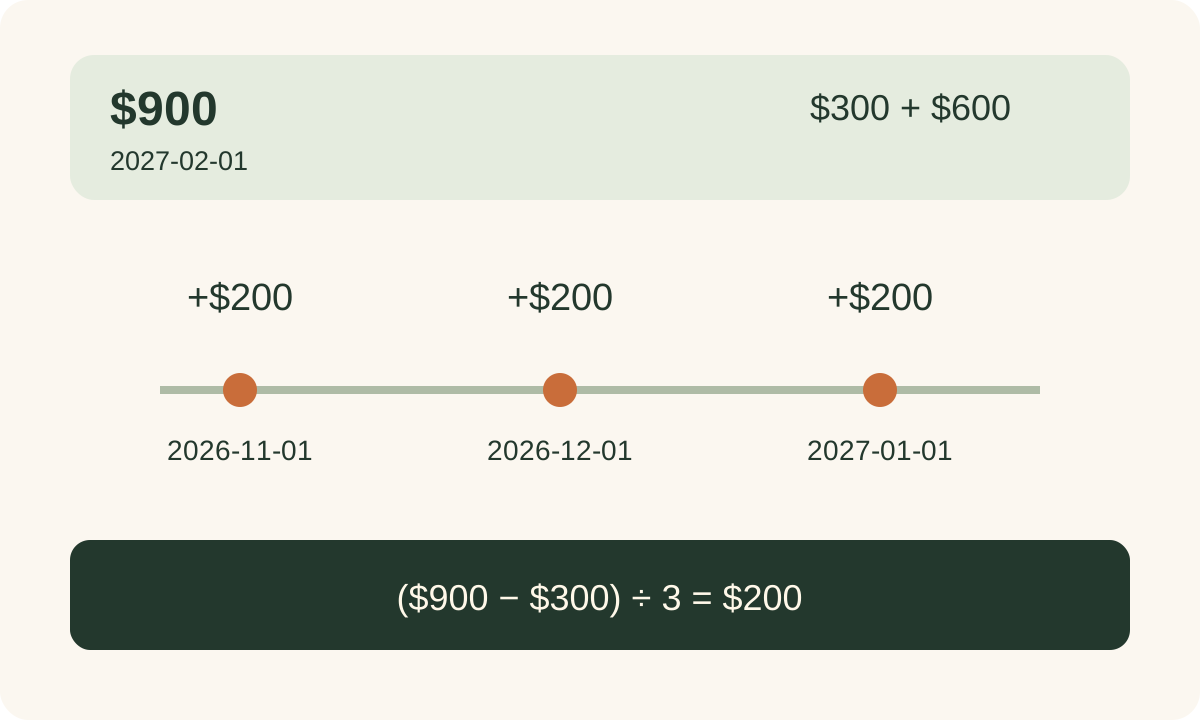
A bill due soon: A fictional $900 bill is due on February 1, 2027. You have already reserved $300 for that bill, so the remaining amount is max(0, $900 - $300) = $600. If you can make deposits on November 1, 2026, December 1, 2026, and January 1, 2027, then N = 3 and the target is $600 / 3 = $200 on each date.
A full year to prepare: A fictional $900 renewal is due on December 31, 2027, with $0 already reserved. If the twelve planned deposit dates run from January 1 through December 1, 2027, the target is $900 / 12 = $75 each time. This works because twelve actual deposits fit before the payment deadline, not because every bill should be divided by twelve.
A missed deposit: A fictional $540 annual membership is due on May 15, 2027. You have $90 reserved and plan five deposits: December 1, 2026, January 1, 2027, February 1, 2027, March 1, 2027, and April 1, 2027. The remaining $540 - $90 = $450 is $90 per deposit. If the January 1, 2027 deposit is missed, the balance is $180 after the December contribution, and three planned dates remain. The new target is ($540 - $180) / 3 = $120 per date. If that amount does not fit the cash you have received, write down the gap and review the bill's terms and available options before the deadline. Do not quietly count money that has not arrived or take another fund's balance without updating that goal too.
Keep each dollar assigned once
One savings account can hold money for several bills, but keep a separate balance for each purpose. For example, if an account holds $600, you might assign $350 to insurance, $150 to a membership, and leave $100 unassigned. The same $600 cannot also count as $600 for each bill or as an emergency reserve.
Moving money between your own accounts is a transfer, not new income. If you track a general available balance and separate fund balances, subtract a new assignment from the available balance once. When the bill is paid from its assigned fund, reduce that fund and record the bill as an expense once; do not count the transfer as another expense or subtract the payment from the general balance a second time.
If a bill is revised to $540 after you have reserved $550 for it, the remaining amount is max(0, $540 - $550) = $0. There is no new contribution to make. Reassign the extra $10 only after reducing this fund's balance, so it is not counted toward two goals at once.
Review the plan every week
Once a week, check the next due dates, the latest bill amount, each fund's actual balance, and the number of deposit dates still available. Recalculate when a price or date changes, a deposit is missed, or money is reassigned. A short check makes a shortfall visible while there is still time to consider real options. The CFPB also offers a cash-flow budget tool for comparing money received with expenses over time.
Copyable worksheet
Bill:
Payment deadline (when money must be sent or cleared):
Estimated bill cost:
Amount already reserved for this bill:
Remaining = max(0, estimated cost - amount already reserved):
Scheduled deposit dates before the deadline:
N = number of those dates:
Target per deposit = remaining / N (only if N > 0):
Actual cash added so far:
Current balance assigned to this bill:
Next review date:
If N = 0, the payment is due now or overdue, or there are no deposit dates left before the deadline. Do not divide by zero or describe a future monthly amount as a solution for a past date. Compare the amount due with the amount already reserved, then check the bill's terms and available options with the provider.
Keep planned bills separate from emergencies
A bill with a known date belongs in a spending plan. Emergency savings are for unplanned expenses. The CFPB describes an emergency fund as a reserve for unplanned costs and says the amount needed depends on a person's situation (CFPB emergency fund guide). Give the two purposes separate balances so an annual renewal does not silently use money you meant to keep for an unexpected shock.
An optional Money Vault expense log
If you use Money Vault, you can record expenses there and keep this bill-by-bill calculation separately. Money Vault is an iPhone app; this worksheet does not create an annual-bill calendar or automatically set money aside. View Money Vault on the App Store.
For a basic spending plan, see the five-minute budgeting guide. For the emergency-savings side, see the emergency fund tracking guide. If you are comparing tools for savings goals, see the savings-goal app guide.